

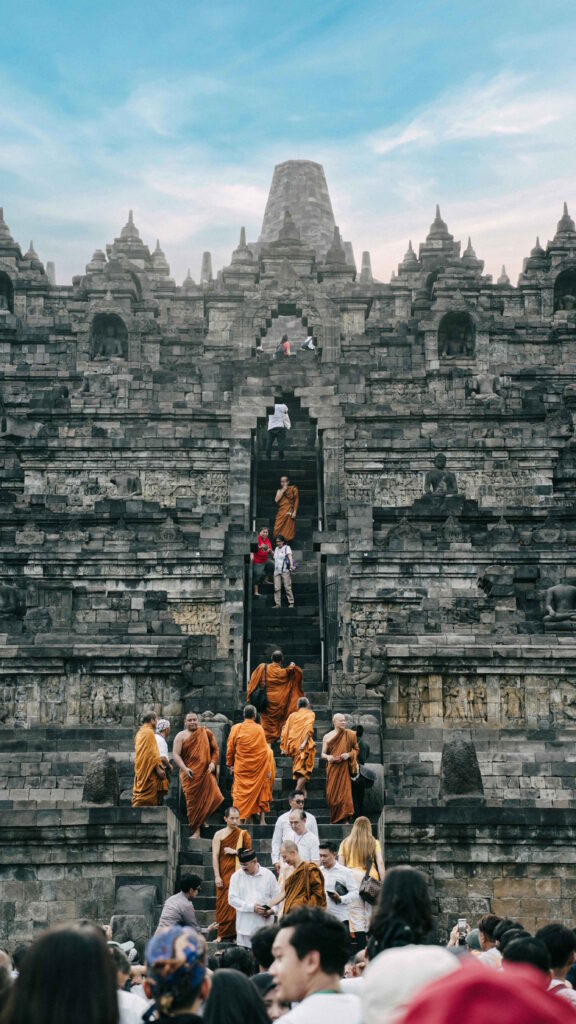
In Mahayana Buddhism, the moment of awakening is not the end of the story. It is the beginning of a larger one. The bodhisattva ideal holds that a being who sees clearly the nature of suffering and its causes does not simply walk away from the world. The vision itself generates a response — a response called bodhicitta, or the mind of awakening, which finds its expression in a vow to remain in service to all sentient beings until every last one is free. This is not piety. It is the direct consequence of understanding how deeply interconnected all experience actually is.
The word bodhisattva combines two Sanskrit roots: bodhi (awakening) and sattva (being). A bodhisattva is a being oriented toward awakening — not only their own, but everyone’s. The Mahayana tradition regards this as the highest possible aspiration a person can hold. Stanford scholar Paul Harrison, writing on Mahayana origins, notes that the bodhisattva ideal arose precisely because early Mahayana practitioners felt the conservative Buddhist goal of personal liberation was incomplete. They believed that Buddhahood — the state of full, complete awakening — required both perfect wisdom and boundless compassion, and that neither could be genuine without the other.
The bodhisattva ideal sits at the heart of Mahayana’s divergence from Theravada. Where Theravada honours the arahant who achieves nirvana and steps out of the cycle of rebirth, Mahayana regards that as a lesser attainment. The bodhisattva, by contrast, voluntarily stays in the cycle to serve, not out of ignorance or attachment but out of the very clarity that could have led to liberation.
The Origin of Bodhicitta
Bodhicitta, often translated as the mind of awakening or the enlightenment mind, is the seed of the bodhisattva path. Mahayana texts distinguish between two aspects of bodhicitta: the aspiration (the wish to attain awakening for all beings) and the engagement (the actual undertaking of the practices that lead there). Together these constitute a fundamental reorientation of one’s entire motivational life.
The generation of bodhicitta is not a one-time event but a progressive deepening. Tibetan texts describe a meditation called tonglen — taking and sending — in which the practitioner visualises taking on the suffering of others with the in-breath and sending relief and happiness with the out-breath. This is not metaphorical. It is a systematic method for loosening the grip of self-preoccupation by training the mind to include others as naturally as it currently includes its own experience.
Nisargadatta Maharaj, whose teaching on the dissolution of the separate self aligns in striking ways with the bodhisattva’s orientation, once said that compassion is the very nature of the self that has seen through the fiction of separation. When the sense of being a bounded, isolated entity loosens, care for others is not a moral achievement but a natural expression of what remains. Bodhicitta, in the deepest Mahayana reading, is not chosen. It arises when the illusion of the self that needed to choose it begins to dissolve.
The Six Perfections and the Bodhisattva Path
The bodhisattva’s path is structured around the six paramitas, or perfections. These are the practices through which the bodhisattva develops the qualities needed to benefit all beings. The six are: generosity (dana), ethical conduct (sila), patience (ksanti), diligence (virya), meditation (dhyana), and wisdom (prajna). Each paramita is not merely a virtue to be cultivated in isolation but a dimension of a single integrated way of being in the world.
Generosity is placed first deliberately. Not because it is the most important but because it is the most accessible. Giving — of material things, of protection, of the Dharma — is the first loosening of the hand that clings. Ethical conduct follows naturally from generosity: when we genuinely give, we stop taking what does not belong to us in any sense, material or psychological. Patience — the capacity to remain steady in the face of difficulty, harm, or the sheer slowness of progress — is considered by many Mahayana teachers the most demanding of the six, because it runs directly counter to every impulse of the self-protective ego.
The sixth paramita, wisdom, is prajna — the direct insight into the empty nature of all phenomena. The Prajnaparamita literature, which forms one of Mahayana’s core textual traditions, is largely concerned with this paramita. The Asia Society notes that in Mahayana teaching, there is finally no distinction between self and other, which means the bodhisattva’s compassion is not an act of altruism performed by a separate self but the natural expression of a mind that sees the non-separation of all beings. Wisdom and compassion, in this understanding, are two aspects of a single recognition.
This brings us to the teaching on anatta, or no-self. The bodhisattva ideal makes no sense without this teaching. If there is genuinely no fixed, separate self, then the boundary between self-liberation and other-liberation is itself a conceptual overlay, not a metaphysical fact. The bodhisattva does not choose to include others out of moral duty. The recognition of non-separation makes the choice redundant.
The Ten Stages of the Bodhisattva
Mahayana maps the bodhisattva’s progress across ten stages called the ten bhumis. Each stage represents a qualitative shift in the bodhisattva’s understanding and capacity to serve. The first stage, called joyful (pramudita), is entered when the bodhisattva generates genuine, stable bodhicitta for the first time. At this point they have an irreversible insight into emptiness, though it is not yet the full awakening of Buddhahood.
Subsequent stages deepen the bodhisattva’s realisation and expand their capacity for action in the world. By the seventh stage, the bodhisattva has developed such stability that they can enter and exit meditative absorption at will without disturbing their engagement with conventional life. The eighth, ninth, and tenth stages represent levels of awakening that exceed what language can accurately describe. At the tenth stage, the bodhisattva’s wisdom is essentially Buddhahood, and the transition to full Buddhahood is understood as the fruition of the entire path.
This structure has important implications for how Mahayana relates to the concept of anicca, or impermanence. Each stage is a further seeing through the illusion of permanence — not just of external objects but of the bodhisattva’s own identity. As the path deepens, the sense of being a fixed, striving entity gives way progressively to the recognition that the awareness doing the striving has always been free.
The Bodhisattva as Transpersonal Reality
In Mahayana cosmology, the bodhisattvas are not only human practitioners progressing along a path. They are also transpersonal beings of immense compassion who have attained near-Buddhahood and whose power is available to those who call on them. Manjushri, the bodhisattva of wisdom, Avalokiteshvara (Guanyin in China), the bodhisattva of compassion, and Tara, the bodhisattva who responds to fear and distress, are among the most widely revered figures in Mahayana Buddhism.
This dimension of the tradition — often called devotional or celestial Mahayana — might seem like a departure from the Buddha’s stripped-down analysis of suffering and its causes. But the Mahayana understanding is that the quality of compassion these figures embody is not foreign to ordinary practitioners. It is what ordinary practitioners are, underneath the conditioning. The bodhisattvas in their cosmic form are not objects of worship in the theistic sense but mirrors — images of what the practitioner’s own deepest nature already is.
Krishnamurti would have resisted the form while recognising the function. He regularly insisted that no authority — not teacher, not tradition, not image — could substitute for direct seeing. But the quality he pointed toward with such urgency — the complete absence of the self-regarding movement of thought in the face of another’s suffering — is precisely what the bodhisattva vow is about. The language differs. The recognition being pointed toward does not.
The Bodhisattva Ideal in Contemporary Practice
In contemporary Mahayana and Vajrayana communities, the bodhisattva vow is taken as a formal commitment. The text varies by tradition but the core aspiration is consistent: may I attain awakening for the benefit of all sentient beings, and may I work until all beings are free. This vow is renewed regularly in practice, functioning not as a reminder of an obligation but as a recalibration of motivation — a way of asking, again and again, who is this practice for?
The practical consequences of this orientation are significant. A practitioner who holds the bodhisattva vow approaches difficulty differently from one who is purely focused on personal liberation. Obstacles are seen as material for practice, not as interruptions to it. Difficult relationships become the primary field of training. The qualities that personal ambition cannot sustain — patience with those who harm you, generosity without expectation, care without possession — become both the method and the measure of progress.
For those exploring these teachings further, the relationship between wisdom and right action is directly relevant. The bodhisattva’s action is characterised by what the tradition calls skillful means (upaya): the capacity to meet each being where they are and offer what they actually need rather than what a fixed doctrine prescribes. This requires a quality of attention that is simultaneously grounded in clear seeing and responsive to what is actually present.
The bodhisattva ideal also speaks directly to the experience of spiritual loneliness that many serious practitioners report. The recognition that one’s practice is not separate from every other being’s suffering — that the aspiration to be free and the aspiration to serve are ultimately one movement — can dissolve the peculiar isolation of the spiritual path in a way that no amount of community-building can.
What the Vow Actually Asks
The bodhisattva vow is, at its surface, an impossible promise. No individual can liberate all sentient beings. The tradition knows this. The point of the vow is not its literal fulfilment but the orientation it establishes. It asks the practitioner to hold every action, every practice, every moment of clarity and confusion, within a frame larger than personal gain or loss.
Ramana Maharshi’s question — “Who am I?” — points toward the same dissolution of personal limitation that the bodhisattva vow enacts from the outside. Self-enquiry collapses the self through investigation. The vow collapses it through the sustained act of placing others at the centre. Two tools, one direction.
The Nagarjuna’s understanding of emptiness gives the bodhisattva ideal its philosophical ground. If all phenomena are empty of inherent existence and arise only in dependence on conditions, then the suffering of any being is not contained within that being’s private bubble. It ripples through the web of interdependence in which all experience participates. The bodhisattva, understanding this, cannot locate a principled reason to stop at the boundary of their own skin.
That borderlessness, in the Mahayana view, is not a sacrifice. It is freedom. And the practice of meditation that deepens it is not preparation for freedom but the direct tasting of it — here, in this breath, before the construction of a separate self has had a chance to reassemble itself again.