

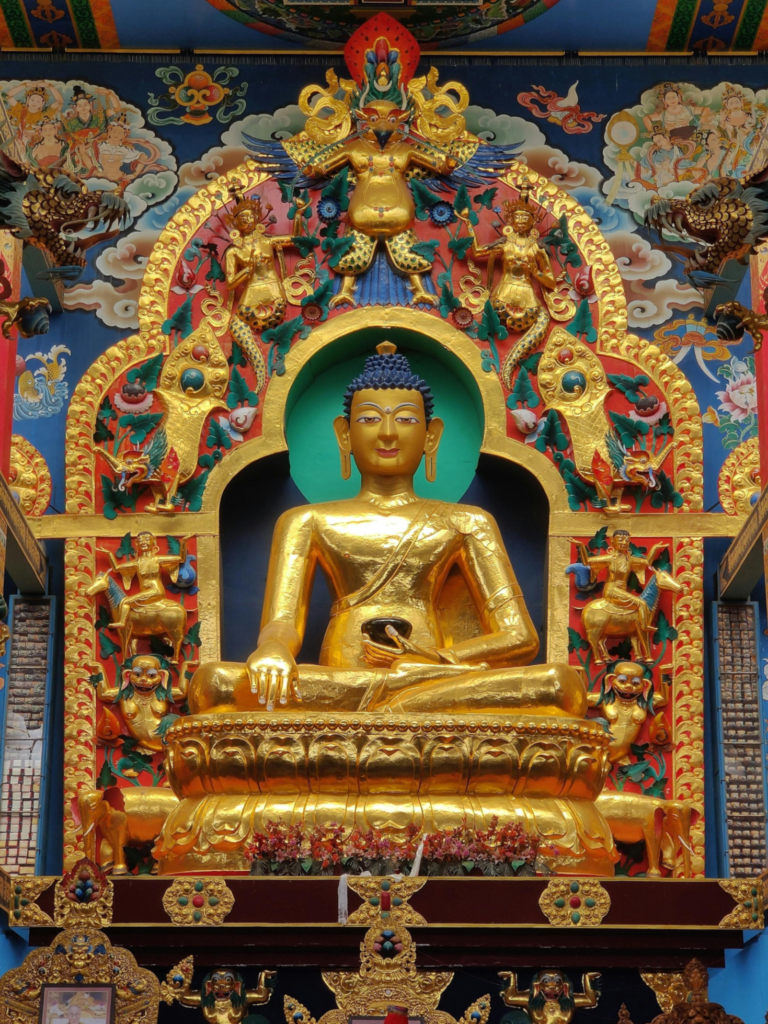
Buddhism did not begin as a religion. It began as a man’s refusal to accept suffering as the permanent condition of human life. Siddhartha Gautama, born into a royal family in Lumbini around 563 BCE in what is now Nepal, spent his early years shielded from the world’s difficulty. When he eventually encountered old age, illness, and death, the contrast with his sheltered existence broke something open in him. He abandoned his palace, his family, and his inheritance to find out what, if anything, could be done about the pervasive dissatisfaction he saw written into every human life.
Six years later, sitting under a bodhi tree near Bodh Gaya in northeastern India, he arrived at something. The tradition calls it enlightenment. He became, in Sanskrit, the Buddha: the Awakened One. What he understood that night, and what he spent the next four decades teaching, became one of the most influential philosophical and spiritual traditions in human history. According to a 2017 report by the Pew Research Centre, Buddhism today has approximately 500 million adherents worldwide, representing around six per cent of the global population.
The Historical and Social Context of Buddhism’s Emergence
Buddhism did not arise in a vacuum. Stanford religious studies professor Paul Harrison has noted that Buddhism emerged during a period of profound social and intellectual ferment in the Indian subcontinent, around the fifth century BCE. The dominant religious framework at the time was Brahmanical Hinduism, which held that an eternal, unchanging self — the Atman — was identical with the ground of all being, Brahman. The Vedic tradition that upheld this view also sanctioned an elaborate ritual system that placed priests at the apex of spiritual authority.
Gautama’s teaching directly challenged both the metaphysical claim and the social structure. He rejected the existence of a permanent self, rejected the authority of priestly ritual, and insisted that liberation was available to anyone willing to undertake sincere practice — monk or layperson, high-caste or low. This combination of philosophical radicalism and social egalitarianism marked Buddhism as a genuinely disruptive force in its time.
The tradition he founded rests on what is known as the Three Jewels: the Buddha himself (the teacher), the Dharma (the teaching), and the Sangha (the community of practitioners). These three form the basis of Buddhist identity and practice across all traditions and geographical regions. Refuge in the Three Jewels is, in most Buddhist schools, the formal act by which a person becomes a Buddhist.
The Four Noble Truths and the Eightfold Path
The Buddha’s first teaching after his awakening, delivered at a deer park in Sarnath to five former companions, is traditionally called the Dhammacakkappavattana Sutta, or the Turning of the Wheel of the Dharma. Its content is structured around what became known as the Four Noble Truths: the truth of suffering (dukkha), the truth of suffering’s origin (samudaya), the truth of suffering’s cessation (nirodha), and the truth of the path leading to cessation (magga).
Dukkha is frequently translated as suffering, but this translation is narrower than the Pali word implies. Dukkha captures the pervasive sense of dissatisfaction, impermanence, and unease that characterises conditioned existence, not only acute pain but the subtle discontent that runs beneath even pleasant experience. The origin of dukkha, according to the second truth, is craving — the compulsive grasping at pleasant experience and the pushing away of unpleasant experience.
The third truth is the most radical: cessation is possible. Dukkha is not a fixed feature of existence but a condition with a cause, and where there is a cause there can be cessation. The fourth truth points to the Noble Eightfold Path as the means of achieving that cessation. The Path covers three broad domains: wisdom (right view and right intention), ethics (right speech, right action, right livelihood), and mental cultivation (right effort, right mindfulness, right concentration). Together, these constitute what the Buddha called the Middle Way — a path between extreme asceticism and sensual indulgence.
Ramana Maharshi, whose inquiry into the nature of the self parallels the Buddha’s diagnosis of suffering in striking ways, held that the root of all psychological difficulty is the false sense of being a separate, bounded entity. The Buddha’s analysis of craving points to the same root: it is only because we believe in a permanent self that we cling so desperately to what seems to sustain it.
Dependent Origination and the Three Marks of Existence
Underlying the Four Noble Truths is a more fundamental philosophical principle: pratityasamutpada, or dependent origination. The Buddha taught that nothing arises independently. Every phenomenon arises in dependence on conditions, and when those conditions dissolve, the phenomenon dissolves with them. There is no uncaused cause, no self-existent entity, no phenomenon that stands apart from the web of interdependence.
This principle finds its ethical and psychological expression in the Three Marks of Existence — anicca (impermanence), dukkha (suffering), and anatta (no-self). All conditioned phenomena are marked by these three characteristics. The tendency to treat impermanent things as permanent, and to treat the aggregate of mental and physical processes we call a self as a unified, lasting entity, is precisely the misunderstanding that generates the cycle of craving and suffering. Buddhist practice, in all its forms, is fundamentally concerned with seeing through this misunderstanding.
Nisargadatta Maharaj cut to the same point from a different angle. He taught that the belief in being a separate person is a concept layered over pure awareness, not the awareness itself. What Buddhism calls the illusion of self, Nisargadatta called the overlay of conditioning on the simple fact of being. The therapeutic aim is the same: to see what is actually present rather than what the conditioned mind projects.
Karma, Rebirth, and the Goal of Liberation
Buddhism inherited from the Indian philosophical tradition the concepts of karma and rebirth, but reinterpreted them in ways consistent with the no-self doctrine. Karma, in Buddhist usage, refers to intentional action — specifically, the moral quality of intention that shapes future experience. Every volitional act plants a seed in consciousness that will bear fruit under the right conditions. This is not a crude system of reward and punishment but a description of how habitual patterns of mind perpetuate themselves across experience.
Rebirth, in Buddhist teaching, does not require a soul or self that transmigrates from body to body. What continues is not an essence but a stream of consciousness conditioned by karma — a flame passed from candle to candle, similar but not identical. The goal of Buddhist practice is not a better rebirth but liberation from the cycle altogether. This liberation is called nirvana in Sanskrit, or nibbana in Pali. The Britannica describes nirvana as a state of complete liberation from the causes of suffering, characterised by the cessation of craving and the collapse of the sense of a separate self.
The path toward liberation is structured, in most Buddhist schools, around the cultivation of sila (ethical conduct), samadhi (meditative concentration), and prajna (wisdom). These three trainings work together: ethical conduct creates the conditions for a settled, undistracted mind; concentration deepens that settledness; wisdom, arising from concentrated attention directed toward the nature of experience, sees through the illusion of permanence and selfhood.
The Spread of Buddhism and Its Major Traditions
After the Buddha’s death, around 483 BCE, his followers organised his teachings and gradually dispersed across the Indian subcontinent. A crucial moment in Buddhism’s spread came with Emperor Ashoka of the Mauryan Empire in the third century BCE. Having converted to Buddhism following a particularly brutal military campaign, Ashoka promoted the Dharma throughout his empire and sent missionaries to Sri Lanka, Central Asia, and the Hellenistic world. His son Mahinda is credited with establishing Buddhism in Sri Lanka, from where it spread across Southeast Asia.
Over the following centuries, Buddhism developed into several distinct but related traditions. The Asia Society notes that a major split occurred around the first century CE between what became known as the Mahayana and the more conservative Hinayana schools. Theravada, Mahayana, and Vajrayana each represent distinct approaches to the Buddhist path, shaped by different philosophical emphases, textual canons, and geographical contexts. Theravada, preserved primarily in Pali texts, remains the dominant tradition in Sri Lanka, Thailand, Myanmar, and Cambodia. Mahayana spread through Central Asia into China, Korea, Japan, and Vietnam. Vajrayana, with its elaborate tantric practices, took hold in Tibet and Mongolia.
Each tradition maintains the Four Noble Truths and the Eightfold Path at its foundation, but builds on that foundation in different ways. Mahayana’s distinctive contribution is the bodhisattva ideal — the aspiration to attain enlightenment not for oneself alone but for the liberation of all beings. Vajrayana adds an esoteric dimension of tantric practice, working with the subtle energies of the body-mind system to accelerate the path toward awakening.
The Core Teachings in Contemporary Perspective
What Buddhism offers, stripped of cultural accretion, is a precise phenomenological investigation of the nature of experience. The teaching on anatta, or no-self, is not a metaphysical denial of the person but an invitation to look carefully at what we actually find when we search for the supposed experiencer behind experience. The teaching on anicca, or impermanence, is similarly not a pessimistic pronouncement but a description of what is plainly observable: that nothing arising in experience lasts.
Krishnamurti, whose approach to liberation had much in common with the Buddha’s diagnostic method, described the conditioned mind as the primary source of conflict — not external circumstances but the habitual patterns of thought, memory, and identification that perpetuate the sense of a separate observer looking out at a separate world. The Buddha’s teaching on dependent origination makes the same point in structural terms: the sense of a separate self arises dependently, not essentially, and can therefore cease.
The Madhyamaka philosophy of Nagarjuna took the Buddha’s teaching on emptiness to its logical conclusion: not only persons but all phenomena are empty of inherent existence. This emptiness is not nothingness; it is the quality that makes change, relationship, and liberation possible. Everything arises in dependence on conditions, which is precisely why conditions can be altered.
Why Buddhism Still Matters
Contemporary psychology has drawn extensively on Buddhist frameworks. Mindfulness-based cognitive therapy, acceptance and commitment therapy, and a range of contemplative practices now embedded in mainstream clinical practice trace their lineage, directly or indirectly, to Buddhist insight meditation. Research on attention, emotion regulation, and neuroplasticity has found consistent overlap between what long-term meditators report and what neuroscientists observe in their data.
This convergence is not surprising. The Buddha’s central question — why do we suffer, and what can be done about it — is the central question of any honest psychology. The answer Buddhism offers is empirical rather than dogmatic: investigate your own experience with precision, and what you find will point toward the causes of your suffering and the conditions under which it ceases. The tradition provides a map, not a destination it can hand you.
For those interested in exploring these teachings in depth, inner peace and its conditions are examined across many dimensions on this site. Similarly, the stages of spiritual awakening offer a broader context for understanding where Buddhist practice fits within the larger arc of contemplative development. The further question of how to be happy in life points ultimately to the same territory the Buddha mapped: the relationship between the quality of attention and the quality of experience.
Buddhism at its heart is not a consolation but a challenge. It asks whether you are willing to look at the structure of your experience without flinching, and to follow what you see wherever it leads. That is a question as alive now as it was in a deer park in Sarnath twenty-five centuries ago. What you do with the answer is, as it always was, entirely up to you.