
Most people who encounter Zen for the first time arrive at the wrong door. They encounter a slogan, a garden, a paradox, and they mistake the packaging for the content. Zen Buddhism is not an aesthetic or a mood. It is a living practice tradition rooted in the direct realisation of one’s own nature, and it has shaped the spiritual and cultural life of East Asia for over a thousand years.
The word “Zen” is the Japanese pronunciation of the Chinese “Chan,” which itself translates the Sanskrit dhyana, meaning meditation. The Stanford Encyclopedia of Philosophy notes that Zen owes its historical origin to early Indian Buddhism, where deepened meditation called samadhi was one of three disciplines a practitioner was required to master, alongside ethical precepts and non-discriminatory wisdom. What distinguished Chan from other Buddhist forms was not a new doctrine but a new insistence: awakening was available here, now, through direct experience, and not primarily through scriptural study.
The tradition arrived in China in the fifth or sixth century, attributed by legend to the Indian monk Bodhidharma. Britannica records that Chan first rose to genuine prominence in the early eighth century, during the Tang dynasty, gaining significant imperial patronage before spreading into rival schools during the subsequent Song period. It reached Korea, where it became Seon, then Japan, where it arrived firmly in the thirteenth century. The samurai class adopted it readily, and it became the dominant form of Buddhism in Japan between the fourteenth and sixteenth centuries.
The Foundational Claim
Zen rests on a single radical claim: all sentient beings already possess Buddha-nature. Bodhidharma articulated this as a special transmission outside the scriptures, pointing directly to the human mind, seeing one’s true nature and becoming a Buddha. The goal is not to acquire something new but to recognise what has never been absent.
This is the same territory Ramana Maharshi mapped. His practice of self-enquiry, asking “Who am I?”, was designed not to arrive at an answer but to dissolve the questioner. The recognition that the Self is always already present parallels Zen’s insistence that Buddha-nature is not a state to be attained through accumulation.
The concept at the heart of this recognition is shunyata, or emptiness. It is one of the most misunderstood terms in any contemplative tradition. Emptiness does not mean nothingness. It means all phenomena are empty of fixed, independent existence. Nothing exists in isolation. The Heart Sutra, the most frequently recited text in Zen temples worldwide, states that form is emptiness and emptiness is form. This is not poetic wordplay. It is a direct description of how things actually are. For a deeper look at how this teaching intersects with non-duality, the article on Zen vs Advaita explores this convergence in detail.
Zazen: The Practice
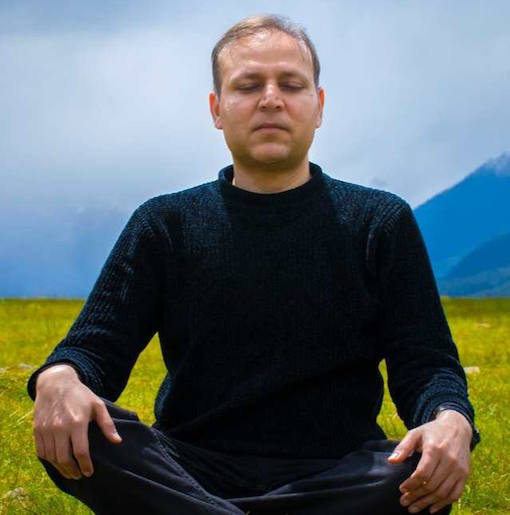
Zazen, or seated meditation, is the central practice of Zen. In the Soto school, it is practised as shikantaza, meaning “just sitting.” There is no object, no goal, no technique of concentration beyond the sitting itself. Dogen Zenji, founder of Japanese Soto Zen, taught that zazen is not a means to enlightenment but its very expression. Practice and awakening are, in his teaching, inseparable.
In the Rinzai school, zazen is combined with koan practice, where students sit with paradoxical questions that cannot be resolved by analytical thought. A koan such as “What is the sound of one hand?” is designed not to be solved but to exhaust the discriminating mind, creating conditions for direct insight. The Stanford Encyclopedia describes the koan as formulated like a riddle, designed so that intellectual reasoning alone cannot solve it without breaking through ego-consciousness.
Research compiled by Alberto Chiesa in 2009, summarised in ScienceDirect, found that zazen practice creates measurable physiological change: slower breathing, reduced muscle tension, and increased theta wave activity associated with reduced stress and protection against cognitive decline. The body registers what the intellect cannot easily accept.
The Two Main Schools
Japanese Zen today has two dominant forms: Rinzai and Soto. Their differences are real but often overstated. Rinzai practice is characterised as sharp and martial in spirit, emphasising intense koan work and dynamic teacher-student encounters. Soto is associated with a quieter approach, built around shikantaza. A Japanese saying captures the cultural distinction: “Rinzai for the shogun, Soto for the peasants.” Both schools agree on fundamentals: awakening is possible, the teacher-student relationship is central, and daily life is the primary field of practice.
The famous Zen masters of both lineages, from Dogen and Keizan in Soto to Linji, Hakuin, and Bankei in Rinzai, shared a common insistence that insight must be lived, not merely achieved. Nisargadatta Maharaj taught that the sense of being a separate person is itself the primary illusion. This framing converges precisely with Zen’s diagnosis: the ego-consciousness that splits experience into subject and object is not the experiencer of reality but its obstruction.
Impermanence and Continued Practice
Zen takes the Buddhist teaching of impermanence seriously. Nothing that arises lasts. The practitioner who sits with this fact, genuinely rather than philosophically, finds that clinging to any state, including pleasant meditative states, only extends suffering. This is why the tradition warns against what it calls “the stink of Zen”: the subtle attachment to awakening experiences as spiritual possessions.
The stages of practice in Zen are not a ladder to be climbed but a progressive seeing-through of what was never real. Kensho, the initial seeing of one’s nature, is not the end of the path. Dogen explicitly critiqued the idea that enlightenment is a single event. Post-awakening practice deepens realisation, removes residual conditioning, and finds expression in compassionate daily action.
- Krishnamurti described the conditioned mind as the source of suffering and rejected all authority in spiritual seeking, including the authority of accumulating experiences. Zen, at its sharpest, shares this suspicion. The Record of Linji famously advises: if you meet the Buddha, kill the Buddha. It is a statement not about violence but about the danger of fixing awakening into an object of seeking.
Zen and the Ordinary
Perhaps the most counterintuitive teaching in Zen is that ordinary life is the practice. The expression “before enlightenment, chop wood, carry water; after enlightenment, chop wood, carry water” is not a statement about unchanged life but about changed perception. The activities do not change. The fixed idea of a someone performing them falls away.
This is why Zen produced not only meditators but poets, painters, calligraphers, and garden designers. The Metropolitan Museum of Art notes that Zen’s emphasis on simplicity and the natural world generated a distinctive aesthetic expressed through wabi and sabi, a sense of rustic beauty and impermanence in which a worn, misshapen jar is considered more beautiful than a pristine one. The aesthetic and the practice share the same root: nothing is added, nothing is forced.
The inner peace that Zen points toward is not a calm that requires the world to cooperate. It is an ease with what is, found in the midst of full engagement. Practice does not withdraw from life. It returns to it more fully, without the distortion of an ego that constantly translates experience into self-referential stories.
What Zen Is Not
Contemporary Western usage has extracted “zen” from its context and made it synonymous with relaxed minimalism. This is a significant distortion. Zen training in its traditional forms is demanding. Retreats called sesshin involve long days of intensive sitting, sometimes up to ten hours. The teacher-student relationship can be confrontational. The aim is not comfort but clarity.
The teacher cannot give a student awakening. What a teacher can do is disrupt the student’s habitual self-conception at the right moment, remove false support structures, and recognise genuine insight when it appears. This is why dharma transmission matters in Zen. The lineage is not a bureaucratic credential but a living chain of recognised awakening, stretching from the historical Buddha to the present. Reading Zen quotes drawn from this lineage can offer a first encounter with the flavour of the teaching.
- T. Suzuki, the Japanese scholar whose mid-twentieth-century translations introduced Zen to Western audiences, was both its most effective advocate and, some scholars argue, its most creative reinterpreter. His emphasis on satori as a private mystical experience has been challenged by scholars who point out that Zen training is deeply embedded in cultural forms, literary study, and institutional practice. The full picture of Zen includes both the lightning of insight and the long work of embodiment.
The Entry Point
Zen does not promise escape from the world. It promises a different relationship to it. The practitioner who has genuinely seen through the illusion of a fixed, separate self does not disappear. They return to ordinary life with the same wood, the same water, but without the compulsive self-maintenance that made ordinary life a source of constant friction.
For a beginner, the entry point is simple: sit down, be quiet, notice what arises without following it. The guided mindfulness practice at innerspiritualawakening.com offers a starting point. But Zen has always insisted that instruction can only point. The actual work is yours, and it happens in this moment, not in a future one.
What draws people to Zen across cultures and centuries is not its difficulty but the straightforward nature of its claim. You are already what you are looking for. The search is real, the effort is real, but the destination was never separate from the seeker. That recognition, sudden or gradual, dramatic or quiet, is what the tradition calls awakening.