
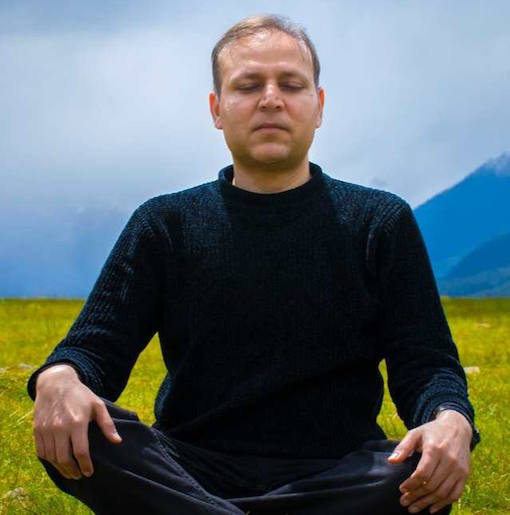
Ego’s Demand for Permanence
Seeker: I’ve been studying Vedanta and reading a lot of the teachings of Ramana Maharishi and Nisargadatta Maharaj. For the past year, I’ve been deeply engaged with I Am That by Nisargadatta Maharaj, which has led to numerous profound experiences. I’ve been experiencing intense blissful states that last for 2-3 days, but then the bliss gradually fades. I’m seeking guidance on how to make these blissful states permanent.
Rajiv: Seekers who have advanced to a level where they have experienced the blissful transcendental states will have to deal with this “bliss trap.” The ego has tasted something rare and now demands it again and again. It says, “I refuse pain, I refuse anxiety. I want only that blissful state.”
In my own journey, I went through periods of intense bliss and ecstasy, only to watch those states gradually disappear. When the bliss faded, I became miserable because I wanted the blissful states to stay forever. I longed to be in those states constantly. I kept chasing bliss, not realizing that my very desire to make it permanent was causing my misery. When I let go of the desire for bliss, I began to find peace in what is. The craving for permanent bliss pulled me away from what is. I call it the “bliss trap.”
Bliss is just one of many experiences along the spiritual path. Like all experiences, it has a beginning and an end. It arises and fades away. As a sadhak, your practice is to witness what appears in the mind, without grasping it. Let it rise and pass. You are not the bliss. You are not the pain. You are the space in which all of this arises.
Seeker: During meditation, I feel a sense of oneness with everything, and it is in those moments that bliss arises. However, as the bliss fades, the feeling of separation returns, and that’s where the problem lies. I don’t want to experience that state of separation.
Rajiv: As I said earlier, all states appear and disappear. This rhythm is not the problem. The problem is clinging to a particular state. Let separation appear. Instead of resisting it, begin to allow it to fully unfold. In time, you’ll move from being caught up in the content of consciousness to resting in consciousness itself. Eventually, you’ll see that this consciousness is universal in nature. There are many stages that will unfold as you progress, so try not to get stuck in a particular stage.
Seeker: Thank you, Rajiv, this gives me a lot to reflect on. It’s becoming clearer that the more I try to cling to bliss or avoid separation, the more I lose sight of that underlying awareness. It’s a shift in perspective I hadn’t considered before. This gives me a lot to reflect on.
Beyond Bliss, Beyond Sorrow
Seeker: I have walked this path with intensity and devotion for many years. There was a time when bliss was not a fleeting state but a continuous presence. For one entire year, bliss was not a visitor but a constant companion. There was an unbroken stream of bliss, radiant and all-consuming. Then slowly it began to fade. Over the next six years, my mind became more and more identified, and I found myself yearning for that lost bliss, aching to return to what once was.
Since being in your satsang, something different has emerged; not the ecstasy of bliss, but a vast and unmoving stillness. There is peace, but not the joy I once knew. Is that bliss likely to return?
Rajiv: The phase of bliss that you describe often appears in the early stages of deep inner unfolding. It draws the seeker inward by capturing the attention with its intensity. It serves as a marker, not a destination.
What follows is maturation. The stillness now present is not a lesser version of the previous state but a transition into something more fundamental. This stillness is not the absence of bliss but its root. Bliss once rose from it and has now returned to it.
In this silence, even bliss disappears. But more significantly, the one who seeks bliss also begins to dissolve. What remains is not a state and not an event. It does not fluctuate. It is the unmoving ground in which all fluctuations happen.
Do not chase the echoes of bliss. Let the yearning itself be exposed. Let it burn out at its root. What remains when there is no seeker and no state to be grasped is not an experience but the timeless presence that was always here. This presence goes unnoticed beneath even the most radiant ecstasies. Do you still miss the bliss?
Seeker: I miss it desperately. It is difficult for me to let go of that experience.
Rajiv: Would you trade the bliss for the silence or the other way round?
Seeker: That’s a very difficult question. I felt that the bliss was a sign that I was meditating correctly and my spiritual practice was on track. This profound silence is a new territory. I can see what you are pointing at, but when you walk past a paradise, it is not easy to leave it behind.
Rajiv: If you want the bliss, you can have the bliss. But as I have mentioned before, the bliss trap can be very addictive. This craving for bliss eventually leads to suffering. If you stay with the silence instead and let it dissolve everything, then what remains is not bliss and not sorrow. It is the still ground of being beyond all experiences.
That Which Comes and Goes Is Not You
Seeker: I experience these states of bliss and joy and they feel deeper than anything I’ve known. But then something shifts and resistance begins to creep in. Thoughts return and the body tightens. The stillness begins to fade and the old restlessness wakes up again. When that happens, I feel deeply disturbed. It feels like something precious has been taken away.
Rajiv: Why is one state so desirable and why is there so much resistance to the other state?
Seeker: I associate the qualities of bliss with the state of oneness. If I don’t feel the bliss, it feels like I am doing something wrong. In that blissful state, everything feels perfect and I lack nothing. But then the habitual patterns of the mind emerge. These restless states feel so wrong to me; it feels I am so far away from the mystical heart of my practice.
Rajiv: Both states are two sides of the same coin, the yin and the yang. You cannot crave one and reject the other. The mind keeps repeating, “I do not want the negative state, I only want the bliss.” But totality contains all these states and then some more.
The totality is not offering you comfort, it is offering you truth. And truth includes everything the mind tries to edit out. Until you can sit with both the contraction and the expansion you will remain divided. Awakening comes not when one state replaces the other, but when both are held in the light of awareness and neither is grasped.
If the sense of separation stirs, don’t rush to fix or escape. Look again. These too are forms of the same consciousness, arising from the same source as bliss. You are not these movements; you are the space in which they happen. That space has no preference. It does not call “bliss” good and “anxiety” bad. It does not shrink from anything.
Let the bliss come. Let the unrest come. Know them as passing clouds. You are not the clouds. You are the sky.
Bliss Was Never the Destination
Seeker: After days of restlessness and unease, something unexpected happened. I went to the post office to send a parcel, and out of nowhere an intense wave of bliss swept through me. It was so overwhelming that I could barely stand upright. Every step felt like walking through a flood of joy. When I returned to my office, the joy was still pouring through. It wasn’t ordinary happiness. It was vast and uncontainable and very intense.
Rajiv: Have you felt this kind of bliss before, or is this a new experience for you?
Seeker: I’ve experienced it before, but never for this long.
Rajiv: I recall that two months ago you were struggling with restlessness and agitation, unable to sit still, let alone meditate. Now, you’re experiencing these blissful states, which is a significant shift. These blissful states are extraordinary states that very few people encounter naturally. Many people resort to drugs or other substances, just to feel a fleeting sense of what you’re experiencing.
But it’s important to stay mindful and avoid getting attached to it, otherwise you will fall into the bliss trap. The true challenge is to enjoy the bliss when it arises, without craving it. Only then can you move beyond the temporary experience and find something even deeper.
Seeker: So what should I do when it comes?
Rajiv: When it comes, let it come. Let it flood you. Let it do what it must. But don’t hold on to it. When it fades, as it must, let it fade. Watch its departure the same way you watched its arrival.
Seeker: But isn’t the bliss a sign that I’m getting closer to the truth?
Rajiv: Bliss is a fragrance, but not the flower. It indicates that something is opening, that the usual structures of mind are temporarily dissolved. But even this must be surrendered. Otherwise, you will sit like a beggar outside the gates of spirituality, asking for yesterday’s joy to return.
When you do not resist either bliss or sorrow, then you are ready. You discover the one who remains when all states pass through.
Seeker: I can clearly see that there is a part of me that wants to hold on, to make it stay longer.
Rajiv: Of course. That part has been trained to seek continuity. It is stuck in past memories and wants repetition. When you see that you are not the one experiencing bliss but the space in which bliss arises, the need to hold on disappears.
Running in Spiritual Circles
Seeker: I have spent a lifetime chasing intensity through drugs, relationships, and endless stimulation. The objects of desire shifted, but the underlying movement remained the same. There has always been a restless hunger for something beyond the ordinary.
That same drive has turned toward meditation. Yet something in me wonders: has anything truly changed? The highs now wear a spiritual robe, but the restlessness persists. Am I still caught in the same loop, just under a spiritual disguise?
Rajiv: That’s an important insight you’ve touched on: the parallels between worldly highs and the pursuit of spiritual bliss. Whether you’re chasing after drugs, relationships, or spiritual bliss, the craving remains the same. The mind is always searching for the next fix and keeps you in the loop. The mechanism behind it remains the same: the desire to escape discomfort and to fill a void.
Seeker: That’s exactly what I feel. When I’m in meditation and I touch those blissful states, everything feels perfect. But as soon as it fades, I’m left restless again, longing for it to return. It’s like I’m trapped in the same cycle, but now the stakes feel higher because it’s “spiritual.”
Rajiv: When you were chasing the highs of drugs, you understood on some level that these were temporary and fleeting. But with spiritual bliss, the mind plays a subtler trick. It tells you this is different and this will last forever. So, when it fades, the anxiety feels sharper, because your mind has tricked you into believing that the bliss should be permanent.
The very nature of bliss, like everything else, is impermanent. To demand its permanence is to set yourself up for disappointment, just as you were disappointed when the highs of the material world faded. The real doorway isn’t in the experience of bliss itself, but in the space from which the bliss arises. That space is always there, whether bliss is present or not.
Seeker: It’s frustrating because I thought the whole point of spirituality was to break this cycle! Meditation was supposed to free me from these attachments. But now, I’m realizing I’m just as attached to bliss as I was to my old habits.
Rajiv: Bliss, in itself, is not the problem. It’s a beautiful experience that arises naturally as you deepen your practice. But the moment you start clinging to it or using it as a measure of your spiritual progress, you’re caught again in the very cycle you’re trying to transcend.
Think of bliss like a passing breeze. It’s refreshing, and while it’s there, it feels wonderful. Can you enjoy the breeze without trying to capture it? Can you let it come and go without the desire for more? Let it all flow through you without holding on.
Seeker: I get what you’re saying, but when the bliss comes, it’s so powerful. How can I not want more of that? It feels like what I’ve been searching for my whole life!
Rajiv: It’s natural to want more. But the question is, what are you really searching for? Is it more bliss, or is it freedom from the very search?
Discomfort Is a Doorway
Seeker: Rajiv, there was a moment during a silent retreat where I was immersed in such deep bliss that it felt like I was dissolving into the universe itself. But then a thought struck me: what if my pursuit of bliss is just a way to avoid the emptiness I’m afraid to face?
Rajiv: That emptiness you feel is exactly what you need to turn toward, not away from. I know it sounds counterintuitive, especially when everything in you wants to fill that void. This emptiness is not your enemy. It’s a doorway.
The craving for bliss is really a form of resistance to that emptiness. The mind wants to escape it because it feels uncomfortable. But if you can sit with the emptiness, explore it without needing to change it, you’ll begin to see that what you’re really afraid of is not the emptiness itself, but the mind’s interpretation of it.
Seeker: So the emptiness itself isn’t the problem?
Rajiv: Not at all. It’s the interpretation that creates the discomfort, not the emptiness itself. The emptiness you feel is a gap between experiences. The mind interprets that as a lack. It wants to fill the space with experience, anything to avoid facing the unknown. But if you can meet that void without needing to fill it, something extraordinary happens. You begin to discover that the emptiness isn’t empty at all. It’s full of awareness. It’s the very ground of your being.
Seeker: That’s what scares me. When I sit with that emptiness, it feels like I’m disappearing and losing myself. How do I know I won’t just fall into a void and never come out?
Rajiv: What you’re describing is the fear of ego death. The ego is terrified of its own dissolution. It clings to experiences because they give it a sense of identity. Even when you’re suffering, the mind can say, “I am suffering.” But in the emptiness, there is no such reference point. There is only awareness.
But what feels like losing yourself is actually finding your true nature. The “you” that’s afraid of disappearing is not who you truly are. It’s just a collection of thoughts and fears. When you let go of the need to fill the emptiness, what remains is the vast, boundless presence that has always been there.
Seeker: It’s hard to imagine that letting go of everything could lead to something greater. I mean, if I let go what’s left?
Rajiv: What’s left is what has always been here: the quiet, ever-present awareness that holds everything. You’re not giving up anything real. You’re only giving up the illusions the mind has created, the illusions that tell you that happiness lies in the next experience.
Seeker: You’re not asking me to reject bliss, just to stop needing it. It’s neither denying what arises nor clinging to any of it. Is that the real shift?
Rajiv: Yes. Bliss is a beautiful experience, but it’s not the end goal. The moment you can experience bliss and let it go without clinging, you’ve freed yourself from the bliss trap. And when you stop needing bliss, you find something far more profound: a deep contentment that isn’t tied to any particular state. This contentment comes from the recognition that you are not the temporary states of bliss or emptiness, but the awareness in which all these experiences arise and disappear.